Mujahideen Font: A Bold Arabic-Styled Display Typeface for Modern Design
In the landscape of digital typography, finding a font that bridges the gap between cultural authenticity and contemporary design trends is often a challenge. Many designers struggle to find Arabic-inspired typefaces that feel modern rather than decorative or outdated. Mujahideen emerges as a significant solution in this niche, offering a trendy, Arabic-styled display font that caters specifically to creators looking to make a visual statement. This article provides an objective evaluation of Mujahideen, analyzing its technical specifications, aesthetic qualities, and practical applications for professionals across various creative fields.
Understanding the Core Identity of Mujahideen
Mujahideen is not merely a standard serif or sans-serif typeface; it is a display font designed to evoke the aesthetic nuances of Arabic calligraphy while remaining accessible within Western design workflows. The name itself suggests strength and tradition, which is reflected in the font’s bold, sweeping strokes and distinctive character shapes. For marketers, entrepreneurs, and freelancers, understanding the specific identity of a font is crucial before integrating it into a brand identity or project.
The primary appeal of Mujahideen lies in its ability to function as a headline or accent font. It is not intended for body text due to its complexity and stylized nature. Instead, it serves as a powerful visual anchor. When used correctly, it can add an layer of exoticism, heritage, or artistic flair to posters, album covers, social media graphics, and branding materials. The font’s design language is unmistakably rooted in Arabic script aesthetics, yet it is encoded to work seamlessly with English keyboards, making it a versatile tool for bilingual or cross-cultural design projects.
Technical Specifications and Accessibility
One of the most critical aspects of evaluating any digital asset is its technical implementation. Mujahideen utilizes PUA (Private Use Area) encoding. To understand why this matters, one must look at how fonts are structured. Standard Unicode encoding maps characters to specific code points. However, PUA encoding allows designers to access glyphs that do not have a standard Unicode assignment. In the context of Mujahideen, this means that the font contains a rich library of alternate characters, swashes, ligatures, and decorative elements that might otherwise be inaccessible or difficult to implement.
This encoding method offers several practical advantages:
- Complete Glyph Access: Users can access all available swashes and alternates without needing complex scripting or third-party plugins. You simply type the corresponding key to trigger the special glyph.
- Ease of Use: Because the glyphs are mapped to keys on your keyboard, the workflow remains intuitive. There is no need to open a separate glyph panel in most design software, which speeds up the creative process.
- Flexibility: Designers can mix standard letters with decorative swashes to create unique typographic compositions that stand out from generic templates.
However, it is important to note that PUA encoding requires users to familiarize themselves with the font’s specific mapping system. While most major design applications support PUA fonts, beginners may initially find the learning curve slightly steeper than using standard Unicode fonts. Once mastered, though, the control it offers over typographic detail is substantial.
Aesthetic Characteristics and Visual Impact
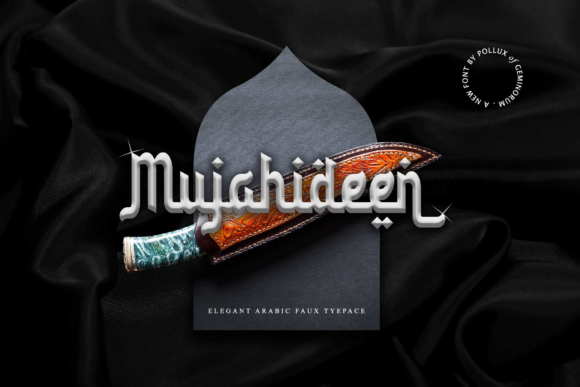
The visual style of Mujahideen is defined by its boldness and fluidity. The letterforms feature thick, confident strokes that taper into sharp points, mimicking the movement of a reed pen used in traditional Arabic calligraphy. This creates a dynamic tension between stability and motion. The font is particularly effective in contexts where energy, passion, or cultural depth is desired.
When evaluating the aesthetic quality, consider the following characteristics:
- Bold Presence: Mujahideen commands attention. It is not a subtle font. This makes it ideal for headlines, logos, and large-format prints where readability at a distance is paramount.
- Cultural Resonance: The Arabic styling gives the font an immediate cultural association. This can be advantageous for brands targeting Middle Eastern audiences or those wishing to incorporate Islamic art motifs into their design.
- Versatility in Styling: The inclusion of swashes allows for variation. A single word can be rendered in multiple ways depending on the chosen alternates, allowing for custom tailoring of each project.
It is worth noting that the heavy stylization means the font does not pair easily with other display fonts. The best practice is to use Mujahideen as the sole typographic voice in a design, or to pair it with very simple, neutral sans-serif fonts for secondary information like dates, subtitles, or contact details.
Practical Applications and Real-World Use Cases
Who benefits most from incorporating Mujahideen into their workflow? The answer depends on the nature of the project. Below are specific scenarios where this font demonstrates high utility.
Branding and Logo Design
For small business owners and startups, especially those in the food, fashion, or entertainment industries, a unique logo font can differentiate a brand in a crowded market. Mujahideen’s distinctive shapes can form memorable logotypes. For example, a restaurant specializing in Middle Eastern cuisine could use Mujahideen for its name, instantly communicating the type of experience customers can expect. Similarly, a music label focusing on world music or fusion genres might use the font to convey a sense of rhythm and global connection.
Event Marketing and Posters
Event organizers, including educators hosting cultural workshops or freelancers designing flyers for concerts, can leverage Mujahideen for high-impact visuals. The font’s bold nature ensures that event titles are legible even from a distance. The swashes add a festive or dramatic touch that aligns well with promotional materials. Whether promoting a Ramadan sale, a cultural festival, or a themed party, the font adds an appropriate atmospheric layer.
Social Media Content
In the age of digital marketing, social media posts compete for attention in a split second. Mujahideen’s strong visual identity helps content stand out in a feed filled with generic templates. Marketers and bloggers can use the font for quote graphics, announcement banners, or thumbnail overlays. The ease of accessing swashes via PUA encoding allows for quick customization, enabling rapid iteration on designs without sacrificing uniqueness.
Packaging Design
Product packaging requires typography that conveys brand values quickly. For products such as spices, cosmetics, or artisanal goods, Mujahideen can add a touch of luxury and heritage. The font’s elegant curves can soften the appearance of a package, making it feel more handcrafted and authentic compared to rigid geometric typefaces.
Evaluating Quality, Reliability, and Long-Term Value
From a professional standpoint, the quality of a font is judged not just by its appearance but by its consistency and reliability. Mujahideen demonstrates a high level of craftsmanship in its stroke weights and spacing. The kerning pairs are generally well-handled for a display font, although designers should always perform manual adjustments when setting tight tracking or leading.
Reliability is another key factor. Since Mujahideen is PUA encoded, there is a slight risk if the font file is not embedded correctly in web projects or shared documents. If a recipient does not have the font installed, the text may revert to a default font or display as boxes. Therefore, it is essential to embed the font in PDF exports or convert text to outlines when sharing final design files. This is a standard practice for any custom display font, but it is particularly relevant here due to the non-standard encoding.
In terms of long-term value, Mujahideen fits into the category of "trendy" fonts. Trends in design evolve rapidly, and a font that is heavily associated with a specific style may feel dated in five to ten years. However, because the font draws on timeless Arabic calligraphic traditions, it has a degree of longevity that purely stylistic fonts lack. It is less likely to become obsolete because its roots are in a historical art form rather than a fleeting graphic trend.
Potential Limitations and Considerations
No design asset is perfect, and Mujahideen has limitations that users should be aware of. First, its bold and complex nature limits its use case. It cannot be used for long-form reading, data visualization, or user interface elements where clarity and speed of reading are critical. Attempting to use Mujahideen for body copy will result in visual fatigue and poor accessibility.
Second, the cultural sensitivity of using Arabic-styled fonts must be acknowledged. While Mujahideen is a Latin-alphabet font styled to look Arabic, it is not actual Arabic script. Designers should ensure that their usage respects the culture and does not misrepresent the font as genuine Arabic calligraphy. Misuse can lead to accusations of cultural appropriation or insensitivity. The font should be used thoughtfully, with an understanding of its aesthetic intent rather than as a substitute for authentic scripts.
Finally, the learning curve associated with PUA encoding, while manageable, is a barrier for some users. Those who prefer plug-and-play simplicity might find the need to memorize key mappings tedious. However, for serious hobbyists and professionals who value customization, this trade-off is often acceptable.
Conclusion: Is Mujahideen Right for Your Project?
Mujahideen is a specialized tool for a specific set of creative needs. It is not a general-purpose font, nor should it be expected to replace standard typefaces in your toolkit. Instead, it serves as a powerful accent font for designers who need to inject personality, cultural resonance, and visual drama into their work.
If you are a marketer, creator, or entrepreneur looking to enhance your visual identity with something bold and distinct, Mujahideen offers a compelling option. Its PUA encoding provides excellent flexibility, and its Arabic-styled design delivers immediate impact. By understanding its strengths and limitations, you can integrate Mujahideen confidently into your projects, ensuring that the outcome is both aesthetically pleasing and professionally executed. For those willing to invest time in learning its mapping system, the reward is a unique typographic voice that stands apart from the crowd.